How To Read A Tea Lab Test Report (Pesticides & Heavy Metals)
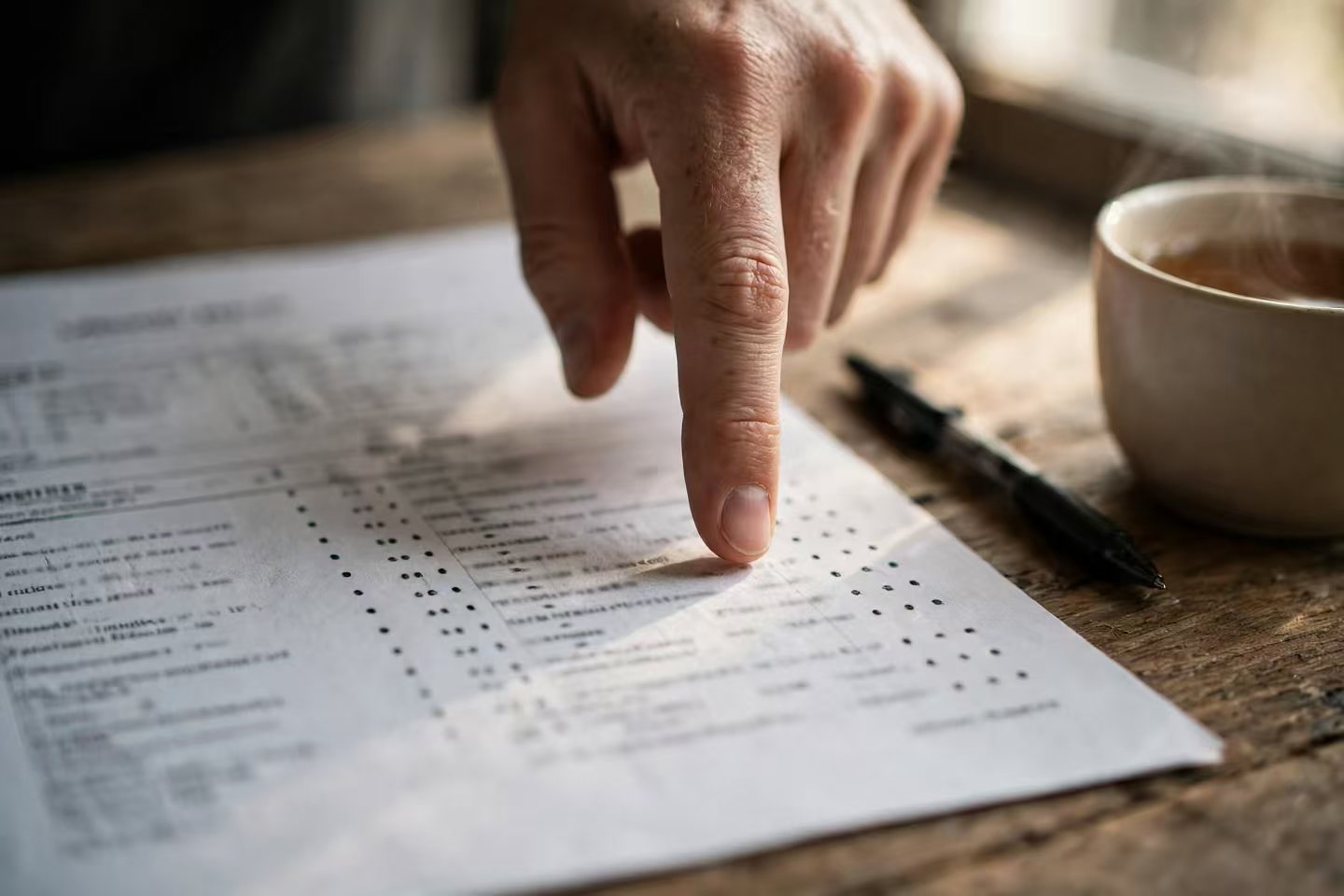
A Certificate of Analysis — often called a COA or test report — is the closest thing a buyer has to evidence about what is in a lot of tea. It is also easy to misread. A page of abbreviations, units and "ND" entries can look reassuring while saying very little, or look alarming while saying something quite normal.
This guide gives you a repeatable routine for reading a tea test report. It focuses on the parts that actually change what the numbers mean: who did the work, which sample it was, what was tested, how low the method could see, and what the result was compared against.
Step 1: Check who did the work
Start at the top of the report. A useful COA identifies the laboratory by name and accreditation. Look for a statement that the lab is accredited to ISO/IEC 17025, the international standard for the competence of testing and calibration laboratories. Accreditation is a sign the lab has demonstrated technical competence for the methods it uses.
A report with no lab name, no address and no accreditation statement is much weaker evidence than one that names an accredited laboratory. Well-known third-party testing firms used for food and tea include Eurofins, SGS, Intertek, Bureau Veritas, ALS and NSF. These are examples of the kind of independent lab you might see — their appearance on a report does not, by itself, validate a particular brand or lot.
Ask one simple question at this stage: who paid for the test, and was the lab independent of the seller? Independence is not the only thing that matters, but a report commissioned and paid for by the party with something to sell deserves the same careful reading as any other.
Step 2: Confirm the sample and the dates
A number without an identity is not evidence. A good report ties the results to a specific sample and lot.
Check for:
- a sample or lot ID that matches the tea you are buying;
- the date the sample was taken and the date the report was issued;
- a clear description of the product tested.
These details connect the document to the goods in front of you. If the lot code on the report does not match the cartons, stop and ask why. It may be a clerical error — or the report may refer to a different batch altogether.
Dates matter too. A report from a previous harvest or a different production run tells you about that material, not necessarily about yours.
Step 3: Find out what was actually tested
Look at the list of analytes — the substances the lab looked for. A pesticide screen might cover a few dozen compounds or several hundred. No routine test covers every pesticide in existence.
This is where "the tea passed" becomes a question rather than an answer. Passed *what*, exactly? If the panel covered 60 substances, the report says nothing about substances outside those 60.
For contaminants, a report may have a separate section covering elements such as lead, cadmium, mercury, arsenic or inorganic tin. Under Regulation (EC) No 1881/2006, the EU sets maximum levels for certain contaminants in foodstuffs, including metals, mycotoxins and other groups. Again, check which substances were included rather than assuming.
Step 4: Read the results column correctly
This is the part that causes the most confusion. Results are usually reported with three pieces of information: the value, the unit, and one or more of LOD, LOQ and a pass/fail flag.
LOD and LOQ in plain words
- LOD (limit of detection) is the lowest amount of a substance the method can detect at all.
- LOQ (limit of quantification) is the lowest amount it can measure with acceptable precision and accuracy.
Every method has a floor. A substance present below that floor cannot be reliably seen or measured. This is why a result of "not detected" (ND) does not mean "zero." It means the amount was below the method's detection capability. The chemical may be absent, or it may be present at a level the test could not register.
When you see ND, look up the LOQ beside it. A result written as "ND, LOQ [value]" tells you far more than "ND" alone: it shows the lowest amount the method could quantify, and that nothing was found above that level.
Units are not decoration
Results are reported in units such as mg/kg (milligrams per kilogram) or µg/kg (micrograms per kilogram). These differ by a factor of a thousand. A number that looks small in one unit can be large in another, and mixing them up is an easy mistake. Always read the unit, and keep it attached to the value when you compare results across reports.
Step 5: Find the limit used for pass/fail
Most reports mark each result as pass or fail against a stated limit. A good COA names that limit. In the EU, the relevant ceiling for a pesticide is the MRL under Regulation (EC) No 396/2005 — either a specific MRL for that substance on tea, or the 0.01 mg/kg default where none exists. For contaminants, the limits come from Regulation 1881/2006.
If a report says "pass" but does not show which limit was applied, ask. A pass against a loose internal specification is not the same as a pass against the legal limit in your market.
Be careful with the language as well. "Compliant" is a legal status; it does not mean the substance was never used, and it does not mean the amount was zero.
Step 6: Notice the measurement uncertainty
For trace elements and contaminants, reports prepared to EU requirements may show results with an uncertainty statement, often written as x ± U, where U is the expanded uncertainty with a coverage factor of 2 — roughly a 95% confidence level. The rules on sampling and analysis for these substances are in Regulation (EC) No 333/2007.
Why does this matter? Because a decision to accept or reject a lot is not made on the bare number alone. Under those rules, the result is assessed taking measurement uncertainty and recovery into account. A lot is accepted where the result does not exceed the maximum level once those factors are considered, and rejected where it exceeds it beyond reasonable doubt.
For a buyer, the practical lesson is twofold. First, a value very close to a limit is not necessarily a clean pass or a clear failure — it may need careful interpretation. Second, a report that shows no uncertainty information for contaminant work is less informative than one that does.
Step 7: Remember that sampling is statistical
The report describes the sample, not the whole shipment. Testing one bag from a lot cannot prove that every bag in that lot is compliant. Sampling is statistical, and general sampling principles — such as those reflected in ISO 2859 — exist precisely because a single result carries uncertainty about the wider lot.
This is why serious buyers ask how the sample was drawn: from how many points in the lot, by whom, and by what procedure. An excellent lab result from a poorly chosen sample is still a poor picture of the lot.
Red flags worth acting on
Pause and ask questions if you see:
- no lab name, address or accreditation;
- a lot code that does not match your goods;
- "ND" results with no LOD or LOQ shown;
- no unit, or units that change between rows;
- "pass" with no stated limit;
- a report for a different harvest, product or supplier;
- sampling details the seller will not explain.
None of these proves anything is wrong. Each is a reason to request clarification before you rely on the document.
A five-minute reading routine
When a COA lands in your inbox, run through this sequence:
- Who — lab name and ISO/IEC 17025 accreditation.
- What — sample and lot ID, product description, dates.
- Which — the analyte panel, for pesticides and for contaminants.
- How low — LOD/LOQ beside each "ND."
- What value — result, unit, and the limit used for pass/fail.
- How certain — uncertainty statement for contaminant results.
- How sampled — how the sample was taken from the lot.
Do this consistently and you will read reports far more accurately than someone who jumps straight to the "pass" column.
Bottom line
A tea lab report is useful only when you can connect the numbers to a sample, a method and a limit. Check the lab's name and ISO/IEC 17025 accreditation, confirm the lot ID and dates, read the analyte panel, and treat "ND" as below the method's detection capability rather than a true zero. Mind the units, identify the limit behind each pass/fail, and note measurement uncertainty where it is given. Finally, remember that a report describes a sample, not an entire lot — sampling is a separate discipline from analysis, and both matter.
Sources & further reading
- Regulation (EC) No 1881/2006 (contaminants) — https://eur-lex.europa.eu/legal-content/EN/LSU/?uri=CELEX:32006R1881
- Regulation (EC) No 333/2007 (sampling/analysis) — https://eur-lex.europa.eu/legal-content/EN/TXT/HTML/?uri=CELEX:02007R0333-20191214