Lead and Arsenic In Tea: Risks and Safe Testing Standards
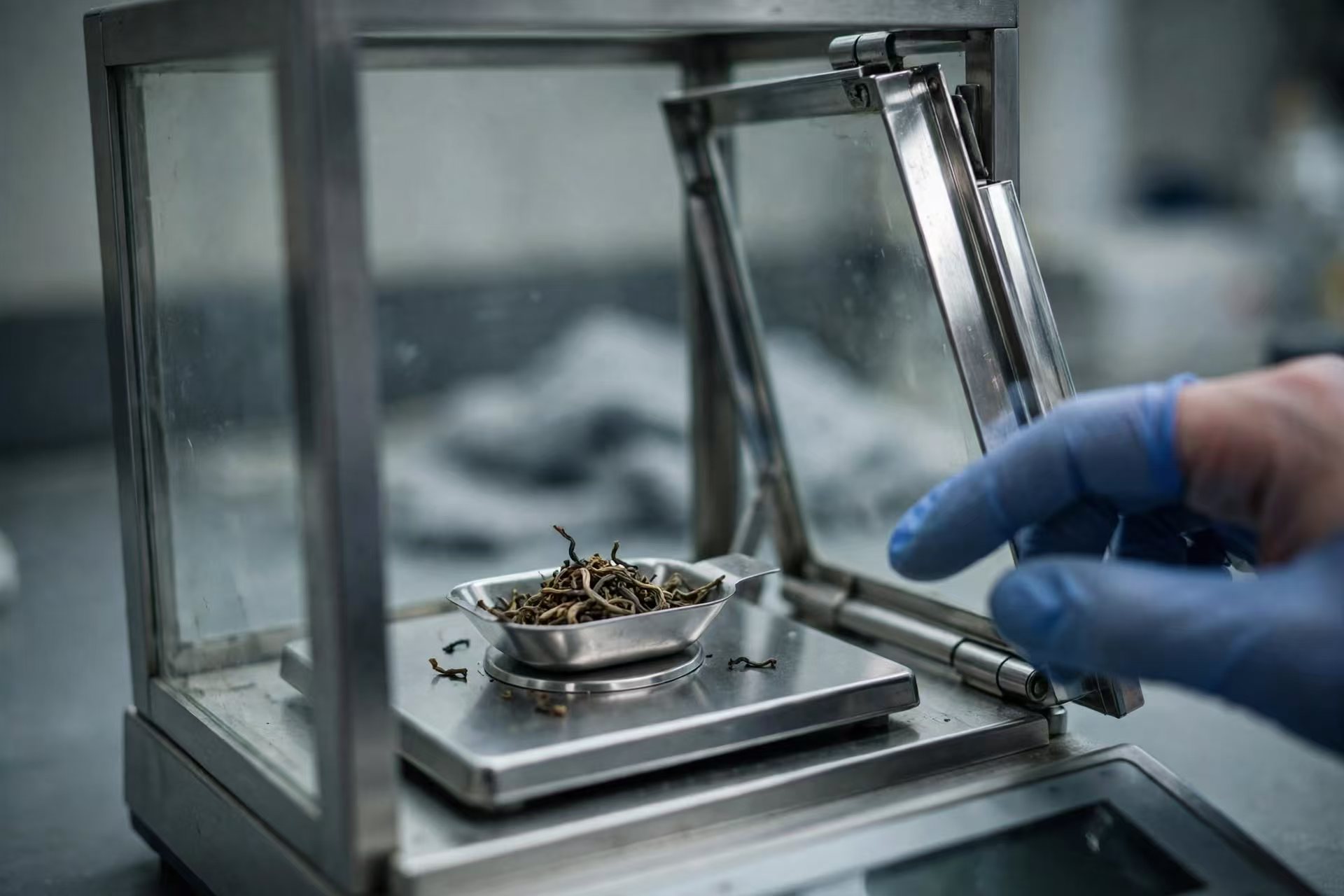
Lead and arsenic come up more than almost any other contaminant question in tea. Buyers want a number — a legal maximum they can hold a supplier to. The honest answer is more awkward, and more useful than a made-up figure: EU law does not set a single dedicated lead limit specifically for tea leaves.
That does not mean tea is unregulated. It means the control comes from a different combination of rules, enforcement and testing. This article explains what the law actually covers, where the gaps are, and how a careful buyer closes them with documentation.
The fact that surprises people
Let us get this out of the way first, because it affects everything else.
EU contaminant maximum levels are set in Commission Regulation (EC) No 1881/2006. The lead maximum levels were updated by Commission Regulation (EU) 2021/1317, which replaced subsection 3.1 on lead. The foods listed in that update include milk, infant formula, cereals, vegetables, fruit, fish, spices, honey, salt and others.
Tea is not listed as a separate commodity with its own lead maximum level in that list. It is important to be precise here: dried spices do have their own lead limits in that regulation, but tea is not treated as "dried spices" under it. Borrowing a spice figure and presenting it as a tea limit is a common error, and it produces a number that has no legal standing for tea.
The safe and accurate way to say it is this: EU law sets contaminant maximum levels in Regulation 1881/2006, but it does not set a single dedicated EU-wide lead limit specifically for tea leaves. Buyers therefore rely on import controls, national enforcement and their own COA testing.
If someone quotes you a precise "EU lead limit for tea," ask them to point to the exact provision.
What the EU contaminant regulation does cover
Regulation 1881/2006 is still the central reference. Its scope includes metals — lead, cadmium, mercury, inorganic tin and arsenic — along with mycotoxins, 3-MCPD, dioxins and PCBs, polycyclic aromatic hydrocarbons, melamine, nitrates, perchlorate and other groups.
The core principle is straightforward: food above the maximum levels in the annexes may not be sold. The levels apply to the edible part and to compound, processed, dried and diluted foods. The regulation also prohibits mixing food that complies with food that does not comply — a point with direct relevance to how buyers should respond to a failing lot.
This covers arsenic as a regulated contaminant in the general sense, but it does not give us a tea-specific arsenic number to quote either. Where no specific value is available, the same rule applies as elsewhere in this blog: check the current official text rather than accept a second-hand figure.
A related note on mycotoxins: Regulation 1881/2006 sets ochratoxin A limits for products such as wine, coffee, dried fruit and spices, but there is no dedicated ochratoxin A limit specifically for tea in that annex. Do not let anyone assign one.
Why "no tea limit" is not "no control"
It would be a mistake to read the absence of a dedicated tea lead limit as permission to ignore the issue. Controls arrive through several other routes.
- Import controls. Tea entering the EU is subject to the general framework for food safety and official controls. An importer still needs to be able to show that the product is compliant.
- National enforcement. Member States enforce food law and can act on products on their market. A national authority may take a view on a specific lot even where an EU-wide tea-specific number does not exist.
- Your own testing. In practice, the Certificate of Analysis is the evidence a buyer relies on. If you import tea without contaminant testing, you have very little to stand on if a question arises.
- The ban on mixing. Because Regulation 1881/2006 prohibits blending compliant and non-compliant food, a supplier cannot solve a problem simply by diluting it into a clean batch.
So the practical position is: no single EU tea lead number, but real obligations and real exposure if you cannot document what is in the tea.
How the testing actually works
Since the COA is your main tool, it is worth understanding what goes into it.
The lab and the method
A useful report identifies the laboratory and its accreditation. Look for ISO/IEC 17025, the international standard for the competence of testing and calibration laboratories. Independent firms commonly used for food and tea testing include Eurofins, SGS, Intertek, Bureau Veritas, ALS and NSF — these are examples of labs you may encounter, not endorsements of any particular supplier.
The report should name the analytical method used. For trace elements, you may see techniques such as ICP-MS (inductively coupled plasma mass spectrometry) named — a laboratory approach capable of measuring elements at very low concentrations. Treat that as a description of what the lab did, not as a legal requirement. No regulation says your COA must use one specific instrument. What matters is that the method is named, the lab is competent, and the result is tied to your lot.
Detection limits and "not detected"
Every method has a floor. LOD is the lowest amount detectable; LOQ is the lowest amount quantifiable with acceptable precision and accuracy. A result reported as "not detected" (ND) does not mean zero — it means the substance was below what the method could detect. Always read the LOD or LOQ beside an ND entry before you draw conclusions.
Sampling and measurement uncertainty
For trace elements and contaminants, the EU rules on sampling and analysis are set out in Regulation (EC) No 333/2007. Results may be reported as x ± U, where U is the expanded uncertainty using a coverage factor of 2 — roughly a 95% confidence level.
Decisions are not made on the bare number. Under those rules, a lot is accepted where the result does not exceed the maximum level once measurement uncertainty and recovery are taken into account, and rejected where it exceeds the level beyond reasonable doubt. A result close to a limit therefore needs careful interpretation, not a glance.
Sampling is statistical too. Testing one bag from a lot cannot prove that every bag in the lot is the same. Ask how the sample was drawn and from how many points in the lot.
Questions to ask your supplier
Put these to any seller or importer:
- "Can I see the full COA for this exact lot, with the lab name and accreditation?"
- "Which elements were tested, and which method was used?"
- "What are the LOD and LOQ for the results marked ND?"
- "How was the sample taken, and when?"
- "Is there an uncertainty statement on the contaminant results?"
- "If a result is high, what corrective action was taken?"
A supplier who can answer these calmly is usually worth listening to. One who substitutes a vague assurance for a document is telling you something.
Storage: a brief note on contamination routes
Contaminants are not only an agricultural question. Tea is hygroscopic — it absorbs moisture and odours from its surroundings. High humidity and poor storage can encourage mould growth, which is why good storage practice matters: cool, dry, sealed, away from light and strong smells, with first-in-first-out stock rotation.
Keep this in perspective. Storage conditions are a risk factor for mould and mycotoxins, not a reliable way to remove metals already present in the leaf, and this article is not the place for invented moisture thresholds. What you can control is documentation: test the lot you are actually buying, and store it properly afterwards.
A word on the US side
For tea entering the United States, there is no tea-specific FDA import alert for chemical contamination. Import Alert 99-48 covers detention without physical examination of foods due to chemical contamination across a broad range of human-made chemicals including benzene, dioxins, PCBs and PFAS; it is a general alert, not a tea rule. Under FSVP, your written hazard analysis should consider chemical hazards as part of the importer's own program. Check the official alert list rather than relying on a quoted number.
Bottom line
The key fact is the one buyers most often get wrong: EU law sets contaminant maximum levels in Regulation 1881/2006, but it does not set a single dedicated EU-wide lead limit specifically for tea leaves. Arsenic is among the metals covered by that regulation in general, but no tea-specific number should be invented for it either. Control comes from import controls, national enforcement, the ban on mixing non-compliant food, and your own COA testing. Read reports for lab accreditation, method, LOD/LOQ, lot identity and uncertainty; remember that "ND" is not zero, and that sampling is statistical. Verify each claim against the current official text.
Sources & further reading
- Regulation (EC) No 1881/2006 (contaminants) — https://eur-lex.europa.eu/legal-content/EN/LSU/?uri=CELEX:32006R1881
- Regulation (EU) 2021/1317 (lead MLs) — https://eur-lex.europa.eu/legal-content/EN/TXT/?uri=uriserv:OJ.L_.2021.286.01.0001.01.ENG
- Regulation (EC) No 333/2007 (sampling/analysis) — https://eur-lex.europa.eu/legal-content/EN/TXT/HTML/?uri=CELEX:02007R0333-20191214