Heavy Metal Sources In Tea Soil, Water And Processing
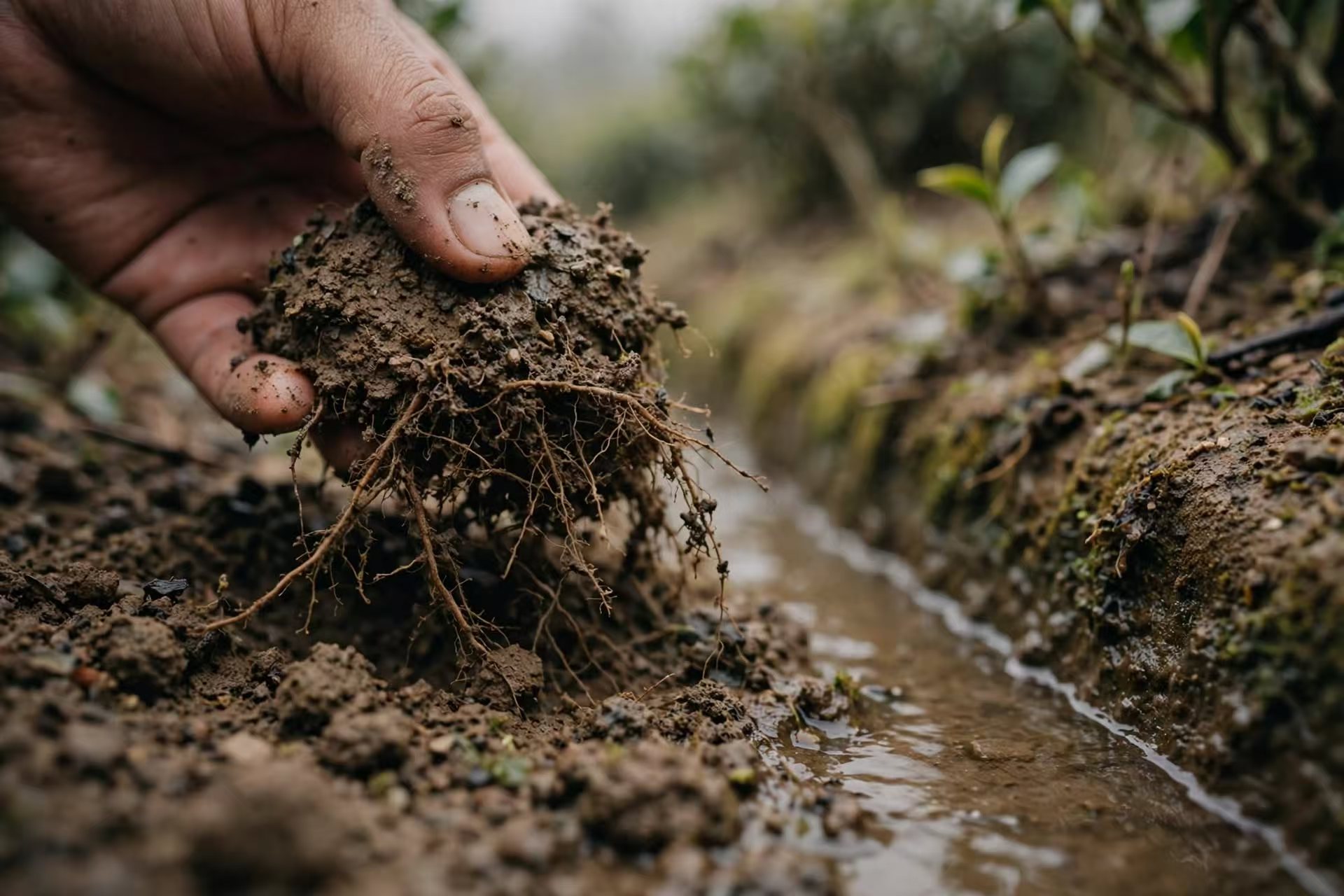
When people hear that tea may contain traces of metals, the mind often jumps straight to a factory. The reality is more ordinary. Metals are a natural part of the ground tea grows in, and they can enter the leaf through several routes long before anyone thinks about processing. Understanding those routes helps you ask better questions and, more importantly, read a test report correctly.
This article is about where metals in tea can come from and how the European rules treat them. It is not about health effects — only safety, limits, sampling and documentation.
First, what "heavy metals" means in a food context
In food regulation, the metals that get the most attention include lead, cadmium, mercury, arsenic and inorganic tin. Regulation (EC) No 1881/2006 is the EU text that sets maximum levels for certain contaminants in foodstuffs, and metals are one of the groups it covers.
Two ideas matter before we look at sources.
- A trace is not automatically a violation. Regulations set maximum levels, not zero. The question is always whether a measured result is above the applicable limit.
- The limit is tied to a specific food and a specific metal. You cannot borrow a number from one commodity and apply it to another. This is a common mistake with tea, and we will return to it.
With that in mind, let us follow the tea plant from the ground up.
Source one: soil and geology
Tea is grown in soil, and soil contains metals naturally. The underlying geology of a region influences how much of each element is present. Some areas simply have more of a given metal in the ground than others. This is not pollution in the everyday sense; it is a feature of the place.
A tea plant takes up water and dissolved minerals through its roots. Whatever is available in the soil solution can, in principle, be taken up and moved into the leaves. The plant does not have a perfect filter that distinguishes desirable from undesirable elements. So the composition of the soil is the first and most basic source of metal traces in tea.
This is why two teas from different regions can differ even when they are the same variety, processed the same way, and harvested at the same time. The origin matters because the ground matters.
Source two: water and the growing environment
Water is the second route. Irrigation water, rain and the general environment of the plantation all contact the leaf. Water can carry dissolved elements from the soil or from the wider area.
It helps to think of the growing environment as a system rather than a set of separate inputs. Soil, water, air and the plant itself exchange material continuously. Dust settling on leaves is another part of that picture. This is one reason why the same farm can produce different results in different seasons: rainfall, dust and growing conditions change.
For a buyer, the practical lesson is that origin and harvest context are part of the safety story. "Same tea, different year" is a real variable, not a marketing phrase.
Source three: processing, equipment and contact materials
The third route arrives after harvest. Tea passes through a chain of steps — withering, rolling, oxidation or fixing, drying, sorting, packing — and each step involves contact with equipment and surfaces.
Metal traces can, in principle, be introduced where machinery, pipes, containers or packaging materials touch the leaf. This is not to say that ordinary equipment is a problem; well-maintained food-grade equipment is the norm. It is to say that processing is a genuine potential source, alongside the field. That is why process control and good manufacturing practice matter, and why a responsible supplier thinks about the whole chain rather than only the farm.
Drying is also a concentrating step. When water leaves the leaf, what remains is more concentrated by mass. A trace present in fresh leaf becomes a larger fraction of the dried product. This is a normal physical effect, not contamination, but it is one reason dried teas are tested as dried product.
What EU law does — and does not — say
Here is the part that most often gets misreported.
Regulation (EC) No 1881/2006 sets maximum levels for contaminants in food, and its metal group includes lead, cadmium, mercury, inorganic tin and arsenic. The regulation also sets out important principles: food above the annex limits may not be sold, the limits apply to the edible part and to compound, processed, dried and diluted foods, and there is a ban on mixing compliant food with non-compliant food.
Now the crucial point for tea. The lead maximum levels were updated by Commission Regulation (EU) 2021/1317, which replaced the lead subsection of the contaminant regulation. The foods listed there include milk, infant formula, cereals, vegetables, fruit, fish, spices, honey and salt. Tea is not listed as a separate commodity with its own lead maximum level in that list.
That has a specific consequence. Dried spices do have lead limits in that regulation, but tea is not treated as "dried spices" under it. So you cannot take a spice limit and present it as a tea limit. If a seller quotes a numeric "EU lead limit for tea," ask them to point to the exact provision — because the generic ones do not contain it.
The accurate statement is: EU law sets contaminant maximum levels in Regulation 1881/2006, but it does not set a single dedicated EU-wide lead limit specifically for tea leaves. Buyers therefore rely on import controls, national enforcement and their own COA testing.
How a result is judged: sampling and uncertainty
Reading a lab report is not as simple as comparing two numbers. Commission Regulation (EC) No 333/2007 covers sampling and analytical methods for trace elements and contaminants in food, and it introduces a detail many people overlook: measurement uncertainty.
Results for these metals are typically reported as a value plus or minus an uncertainty, using a coverage factor of two — roughly a 95 percent confidence level. In practical terms, the laboratory is saying the true value probably lies within a range, not at one exact point.
Under that framework, a lot is generally accepted when the result does not exceed the maximum level once uncertainty and recovery are taken into account, and rejected when it exceeds the limit beyond reasonable doubt. That wording exists for a reason: it avoids treating a borderline measurement as a precise verdict.
This also explains why sampling matters as much as analysis. Testing one bag from a lot does not prove every bag in that lot is compliant. Sampling is statistical, and the way the sample was drawn is part of the result's meaning. A report that does not tell you the lot, the sample and the method is a report you cannot fully interpret.
What a buyer should actually do
You do not need to become a chemist to manage this risk. You need a repeatable process.
- Ask for a Certificate of Analysis. A useful COA identifies the laboratory, its accreditation, the sample or lot ID, the date sampled and reported, the analytes tested, the method, the result with unit, the limit of quantification, and a pass or fail against a stated limit.
- Check which metals were tested. "Heavy metals panel" is vague. Ask which analytes were included.
- Match the lot to the goods. A report for a different lot is not evidence for the tea in front of you.
- Use an accredited lab. ISO/IEC 17025 is the international standard for the competence of testing and calibration laboratories. Labs accredited to it have demonstrated technical competence.
- Remember what "not detected" means. It means the result was below the method's detection capability — not that the metal is literally absent.
- Keep records. For a small importer, the file containing COAs, supplier details and decisions is your defence if a question arises later.
Note also that well-known third-party labs such as Eurofins, SGS, Intertek, Bureau Veritas, ALS and NSF are commonly used for tea testing. Naming a lab is not the same as certifying a brand — the COA itself is what matters.
Bottom line
Metals in tea can come from soil and geology, from water and the growing environment, and from processing and contact materials. EU law addresses contaminants through Regulation (EC) No 1881/2006, but it does not set a dedicated EU-wide lead limit specifically for tea leaves — spice limits are not tea limits. Sampling and measurement uncertainty, covered by Regulation (EC) No 333/2007, mean a result must be read with its context, not as a single magic number. For buyers, the answer is a specific, lot-matched COA from a competent lab, plus basic recordkeeping. Ask which metals were tested, tie the report to the lot, and never accept a borrowed limit as if it applied to tea.
Sources & further reading
- Regulation (EC) No 1881/2006 (contaminants) — https://eur-lex.europa.eu/legal-content/EN/LSU/?uri=CELEX:32006R1881
- Regulation (EU) 2021/1317 (lead maximum levels) — https://eur-lex.europa.eu/legal-content/EN/TXT/?uri=uriserv:OJ.L_.2021.286.01.0001.01.ENG
- Commission Regulation (EC) No 333/2007 (sampling and analysis) — https://eur-lex.europa.eu/legal-content/EN/TXT/HTML/?uri=CELEX:02007R0333-20191214