How Are Tea Samples Tested For Pesticides In European Labs
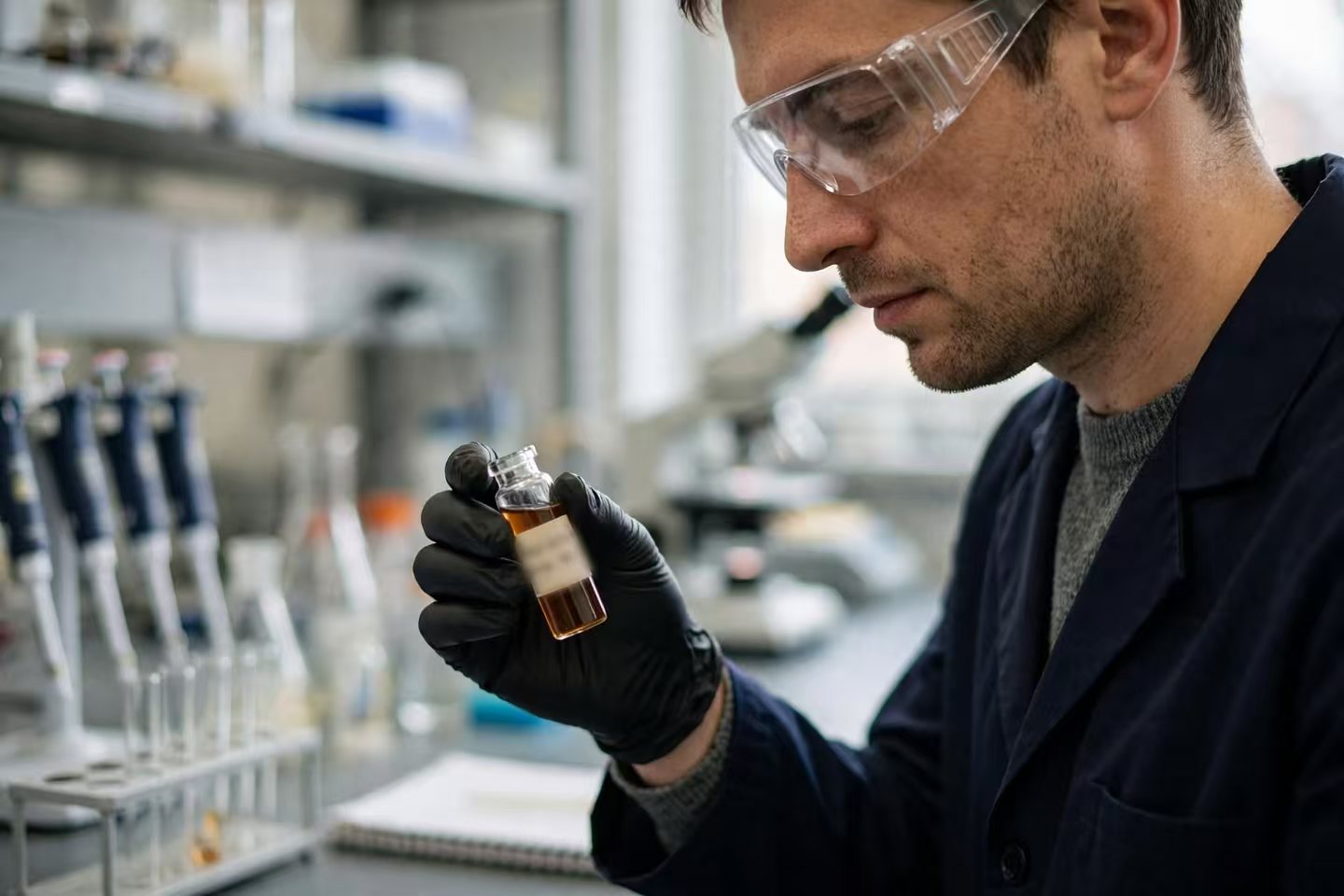
A tea sample arrives at a laboratory. Over the next few days it becomes a set of numbers on a report, and those numbers may decide whether a container clears a European port. The process is more methodical than most buyers realise, and knowing the steps helps you judge whether a result is trustworthy.
This article follows a sample through the main stages — sampling, preparation, analysis, quantification and reporting — and explains the concepts that matter at each one.
Step 1: Sampling happens before the lab
The first and most important step is not done in the laboratory at all. It is sampling: choosing which tea goes into the little bag that gets tested.
This is a statistical exercise. Testing one bag from a lot does not prove that every bag in the lot complies, because residues are not distributed perfectly evenly through bulk tea. General sampling principles, such as those reflected in ISO 2859, exist to give a defined level of confidence about a lot from a limited number of samples. The right plan depends on the lot and the risk; there is no single universal number to memorise.
What matters for you as a buyer is the concept: the result describes the sample, and only by inference the lot. If sampling is careless — one convenient scoop from the top of a sack — even a perfect analysis will mislead you. Ask how many samples were taken and how they were drawn.
Step 2: The lab receives and identifies the sample
When the sample arrives, it is logged and given an identity that ties it to a specific lot. That link is essential. A result with no lot ID cannot be connected back to the tea you intend to buy.
A competent laboratory in Europe will typically work to ISO/IEC 17025, the international standard for the competence of testing and calibration laboratories. Accreditation to this standard means an independent body has assessed the lab's methods, equipment, staff and quality system. Importantly, accreditation has a scope: check that pesticide analysis of tea is actually within the accredited scope, not just that the lab holds a certificate for something.
Step 3: Preparation and extraction
Tea is a dry, leafy matrix, and pesticides are present — if at all — at very low concentrations. The lab's job is to extract the target compounds from the leaf and clean up the extract so the instrument can see them.
This stage is about recovery: how much of the substance actually makes it through preparation to be measured. Good methods are validated to show they recover the analytes reliably. Recovery is one of the reasons a raw instrument reading is not simply the final answer.
Step 4: Analysis and the question of "what did you look for?"
No single test finds every possible pesticide. The lab screens for a defined analyte list — the substances it has been asked to look for. This is why an analyte list on the report matters so much. A clean result for 50 substances says nothing about a 51st that was never tested.
In the EU, the question of which substances matter is tied to the law. Tea is a commodity under Annex I of Regulation 396/2005, in category 06 with code 0610000. Specific MRLs exist for many active substances on tea, and each value must be looked up individually in the EU Pesticides Database. The database is a JavaScript application, so exact per-substance values are not available as simple plain text — articles like this one deliberately teach how to look them up rather than quoting numbers that could go stale.
When you read a report, check that the analytes tested match the substances relevant to your tea and your destination market.
Step 5: Detection, quantification, LOD and LOQ
Here is where many results are misread. The instrument produces signals, and the lab must decide whether a signal means a substance is present and whether it can be quantified.
LOD — limit of detection — is the lowest amount the method can detect at all.
LOQ — limit of quantification — is the lowest amount it can measure with acceptable precision and accuracy.
These are different thresholds. A signal near the LOD may be visible but too unreliable to put a number on. A result is only quantitatively meaningful at or above the LOQ.
This links directly to the EU default MRL. Where no specific MRL exists for a substance on tea, Regulation 396/2005 applies a default of 0.01 mg/kg at the level of quantification. For that default to be meaningful, the lab must be able to quantify at or below it. If the method's LOQ is higher than 0.01 mg/kg, a "not detected" result does not demonstrate compliance — the method was simply not sensitive enough.
Step 6: "Not detected" is not zero
You will often see ND, or "not detected", on a report. It means the substance was below the method's detection capability. It does not mean the amount was exactly zero.
A responsible report gives the LOD or LOQ next to the ND so you can judge how low the detection went. Two labs can both report ND while looking to very different depths. This is one of the strongest reasons to read the whole report rather than the headline pass/fail.
Step 7: Comparing the result with the limit
Once a result is quantified, it is compared with the applicable limit. For tea in the EU that means the specific MRL for the substance if one exists, or the 0.01 mg/kg default where none does.
The regulation is amended frequently, and its annexes change. A comparison is only as current as the version of the limits used. Always confirm which version the lab applied, and check the current consolidated text when in doubt.
A related concept is worth noting for context, even though it belongs to contaminant analysis rather than pesticide analysis. For trace elements and other contaminants, Commission Regulation (EC) No 333/2007 sets sampling and analysis methods and rules on measurement uncertainty. Results may be reported as x +/- U, with an expanded uncertainty using a coverage factor of 2 (about 95% confidence). A lot is accepted when the result does not exceed the maximum level after uncertainty and recovery are taken into account, and rejected when it exceeds beyond reasonable doubt. That is the contaminant framework — useful background on how EU analysis treats uncertainty, but not the rule that sets pesticide MRLs.
Step 8: The report you receive
A useful Certificate of Analysis identifies the laboratory and its accreditation, the sample or lot ID, the date sampled and the date reported, the analytes tested, the method used, the result with its unit, the LOQ and LOD, and a pass or fail against a stated limit.
If a field is missing, ask for it. A number without an analyte list, a unit, an LOQ or a lot ID is a weak piece of evidence, however official the letterhead looks.
Bottom line
Testing tea for pesticides is a chain: representative sampling, accredited laboratory work, extraction, a defined analyte list, detection and quantification against LOD and LOQ, and comparison with the current legal limit. Every link matters. A number is only as strong as the sample behind it and the method used to produce it — and "not detected" always means "below detection", never "zero". Read the full report, and keep the MRL lookup current.
Sources & further reading
- Regulation (EC) No 396/2005 — https://eur-lex.europa.eu/eli/reg/2005/396/oj/eng
- EU Pesticides Database (MRLs) — https://ec.europa.eu/food/plant/pesticides/eu-pesticides-database/start/screen/mrls
- Commission Regulation (EC) No 333/2007 (sampling/analysis) — https://eur-lex.europa.eu/legal-content/EN/TXT/HTML/?uri=CELEX:02007R0333-20191214