Pu-erh Tea Storage: Humidity, Temperature And Contamination Risk
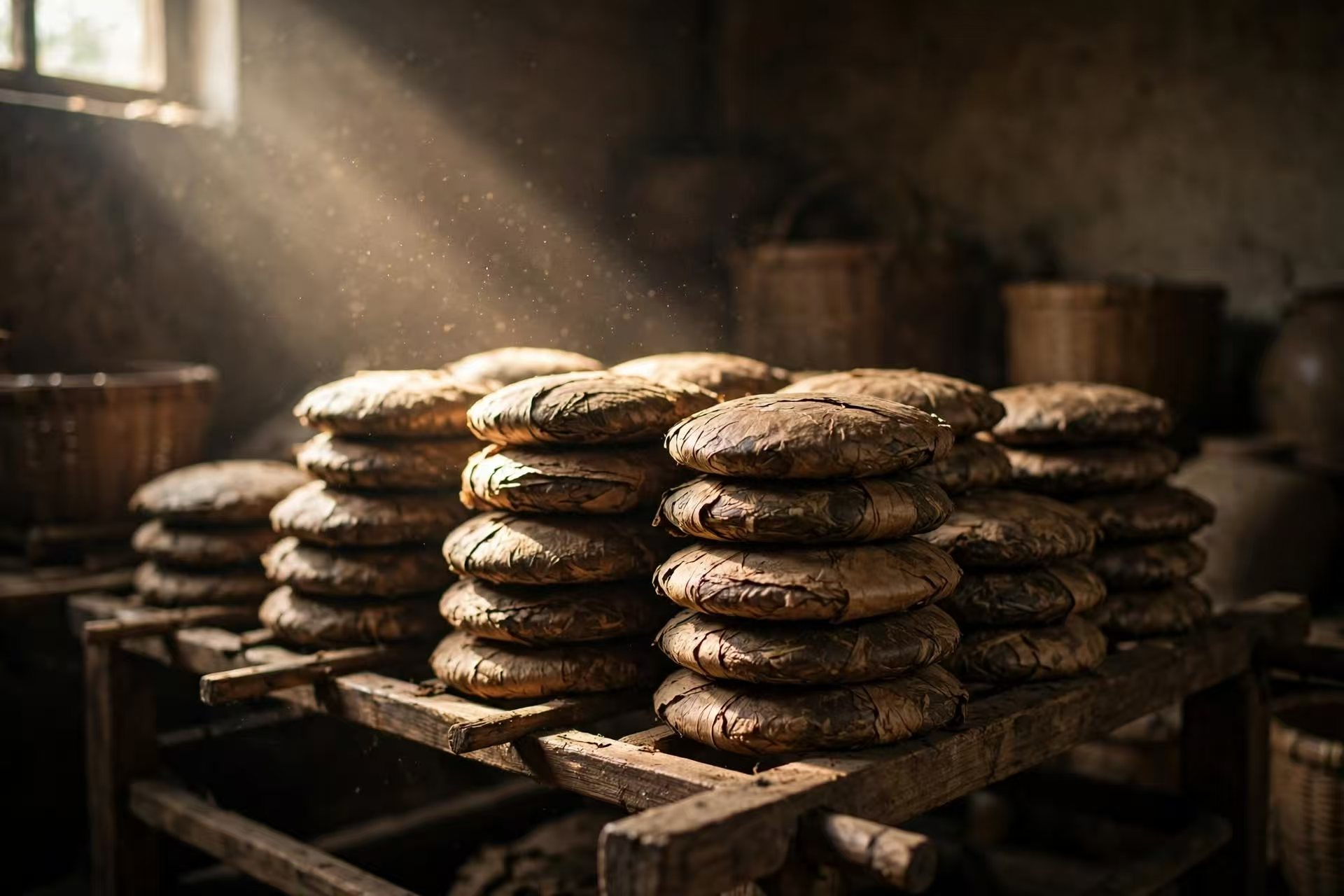
Pu-erh is the one tea many people buy specifically to keep. Green tea is usually at its best when drank young; pu-erh is expected to change with time. That makes storage part of the product, not an afterthought. Store a cake badly and you can end up with something flat, musty-smelling, or — more seriously — carrying mold and the contaminants that can follow it.
This guide explains the storage factors that actually matter, in plain language, and where the safety line sits. It is about storage, residues and compliance, not about the tea's drinking qualities.
Why pu-erh storage is a different conversation
Most tea advice about storage boils down to "keep it dry and sealed." Pu-erh complicates that. Traditional aging expects the tea to interact with its environment slowly. A completely sealed, bone-dry cake may simply not develop, while a cake kept in damp air can go the other way and grow mold.
That tension is why pu-erh storage attracts so much folklore. You will read about exact percentages, special clay jars, and cellar rituals. Very little of that is written into any food law. What the rules care about is the end result: the tea must not be contaminated above the levels the law allows. Your job as a buyer or small importer is to understand the conditions that push tea toward or away from that line.
Tea absorbs water and smells — start there
Tea is hygroscopic. In plain terms, it pulls moisture out of the air around it. Dry tea leaves have a large surface area and very little left bound water, so they readily take up water vapour when the air is damp. Tea also absorbs odours, which is why a cake stored next to spices or cleaning products can pick up those smells.
Two practical consequences follow.
- The storage environment becomes part of the tea. Damp air does not just sit outside the cake; over time it moves into it.
- Packaging matters. A breathable wrapper in a humid room behaves very differently from the same wrapper in a dry one.
This is why "it was fine when I bought it" is not the whole story. A cake can be sound at the seller's warehouse and absorb moisture during a slow, humid journey or in a cupboard at home.
Humidity is the main lever
Of all the storage factors, humidity deserves the most attention. The general pattern is well understood at a conceptual level, even though no single humidity number is written into law as a legal storage limit.
- Too dry, and aging stalls. Tea that is kept very dry tends to change little. That is not a safety problem, but it explains why "aged" tea stored in desert-like conditions may not be what the label implies.
- Too damp, and mold becomes possible. High humidity plus poor airflow creates conditions in which mold can grow on the leaves.
- Stable beats swinging. Repeated cycles of damp and dry are harder on a cake than a steady environment, because condensation and re-drying stress the leaves and packaging.
The key point: there is a broad middle zone in which tea can age slowly without spoiling, and a wet zone where the risk climbs. Law does not define that zone with a magic number, and anyone who quotes a precise humidity figure as if it were a regulation is overstating the case. Treat such figures as rules of thumb, not legal thresholds.
Temperature, light and airflow
Temperature and light matter, but mostly because they interact with moisture.
Temperature. Warm air can hold more water vapour than cool air, so the same relative humidity reading means different things at different temperatures. A store room that is warm and damp is a bigger problem than the same humidity in a cool room. Cool, stable conditions are the safe default. Rapid temperature swings can also drive condensation inside packaging.
Light. Direct sunlight warms the tea and can degrade some aromatic compounds. It is a quality issue more than a contamination issue, but keeping tea in the dark is easy advice to follow.
Airflow. Stagnant, damp air around a cake is the classic mold setup. Gentle air movement and uncluttered storage help. At the same time, a cake should not be left open to a dusty, smelly, or humid room — the very same permeability that lets it age also lets in whatever else is in the air.
So the practical target is: cool, dryish, dark, and reasonably ventilated, in a clean space with no strong odours.
The real contamination worry: mold and mycotoxins
Here is where storage meets compliance. When tea is stored in high humidity with poor airflow, mold can grow. Certain molds are capable of producing mycotoxins — contaminants that food regulations treat as unwanted and control in various foods. Ochratoxin A is one such contaminant often discussed in this context.
A few honest caveats matter:
- Mold growth is a strong sign of poor storage. A visibly moldy cake is not something to "brush off and brew."
- Not all mold produces mycotoxins, and contamination is not something you can judge reliably by smell or sight. A cake can look fine and still be a concern — which is why testing, not intuition, is the basis for compliance decisions.
- Regulation (EC) No 1881/2006 sets maximum levels for a range of contaminants in food, including mycotoxins such as ochratoxin A in products like wine, coffee, dried fruit and spices. It does not set a dedicated ochratoxin A limit specifically for tea. That absence is important: it means buyers cannot point to a single tea-specific number and must rely on broader controls and their own testing.
That last point catches people out. They assume that because a contaminant is regulated in coffee or spices, there must be an equivalent tea number. There is not one in that annex. Always check the current consolidated text rather than relying on a remembered figure.
A storage routine you can actually follow
You do not need a special cellar to store tea safely. A simple routine covers most of the risk.
- Keep it cool, dry and dark. A cupboard away from sunlight, heat sources and damp walls is fine for most households.
- Control the air, not just the container. A sealed tin in a damp room still traps moisture that was in the air when it was closed. Dry the storage space first.
- Avoid odour neighbours. Do not store tea beside spices, coffee, detergents or anything strongly scented.
- Use first-in, first-out. Older stock gets used or reviewed first, so nothing sits forgotten for years.
- Inspect periodically. Look for visible mold, damp clumps, and musty smells. If you find them, set the tea aside rather than trying to sell or drink it.
- Keep records if you sell. For a small retailer, note when stock arrived, where it was stored, and any checks performed. Records turn a vague worry into something you can act on.
None of these steps require a laboratory. They are about not creating the conditions in which contamination can develop.
What to check when buying aged pu-erh online
Storage history is hard to verify from a photograph. A seller can show a beautiful cake and tell you it was kept in ideal conditions. Here are questions that separate a careful seller from a vague one.
- Can they describe the storage conditions? "Traditional storage" means little on its own. Ask whether the tea was kept dry, in a controlled space, and for how long.
- Do they offer a test report? A Certificate of Analysis should identify the lab, the sample or lot, the date, and what was tested. If a seller talks only about age and aroma, that is a gap.
- Is there a lot or batch identifier? Without a lot number, no report can be tied back to the cake in your hand.
- Does the price make sense? Extremely cheap "old" tea may simply be young tea with a story.
Testing is the backstop. Commission Regulation (EC) No 333/2007 covers sampling and analysis methods for trace elements and contaminants in food, and it reflects a broader truth: results depend on how the sample was taken, not just on the instrument. One clean test of one cake is not a guarantee for a whole warehouse. Sampling is statistical, and a thoughtful buyer asks whether testing was done on the lot they are actually purchasing.
Bottom line
Pu-erh storage is a balancing act. Tea absorbs moisture and smells, humidity is the main lever, and high humidity with poor airflow can lead to mold and potential mycotoxin contamination. There is no single legal humidity percentage to hide behind, so treat precise numbers as guidance rather than law. Store tea cool, dryish, dark and clean; use first-in, first-out; and inspect stock regularly. When buying aged tea, ask about storage conditions, demand a real test report tied to a lot number, and remember that EU contaminant law does not provide a dedicated tea-specific ochratoxin A limit to rely on. Your own checks and documentation are what close that gap.
Sources & further reading
- Regulation (EC) No 1881/2006 (contaminants) — https://eur-lex.europa.eu/legal-content/EN/LSU/?uri=CELEX:32006R1881
- Commission Regulation (EC) No 333/2007 (sampling and analysis) — https://eur-lex.europa.eu/legal-content/EN/TXT/HTML/?uri=CELEX:02007R0333-20191214