Can Aging Pu-erh Remove Pesticide Residues?
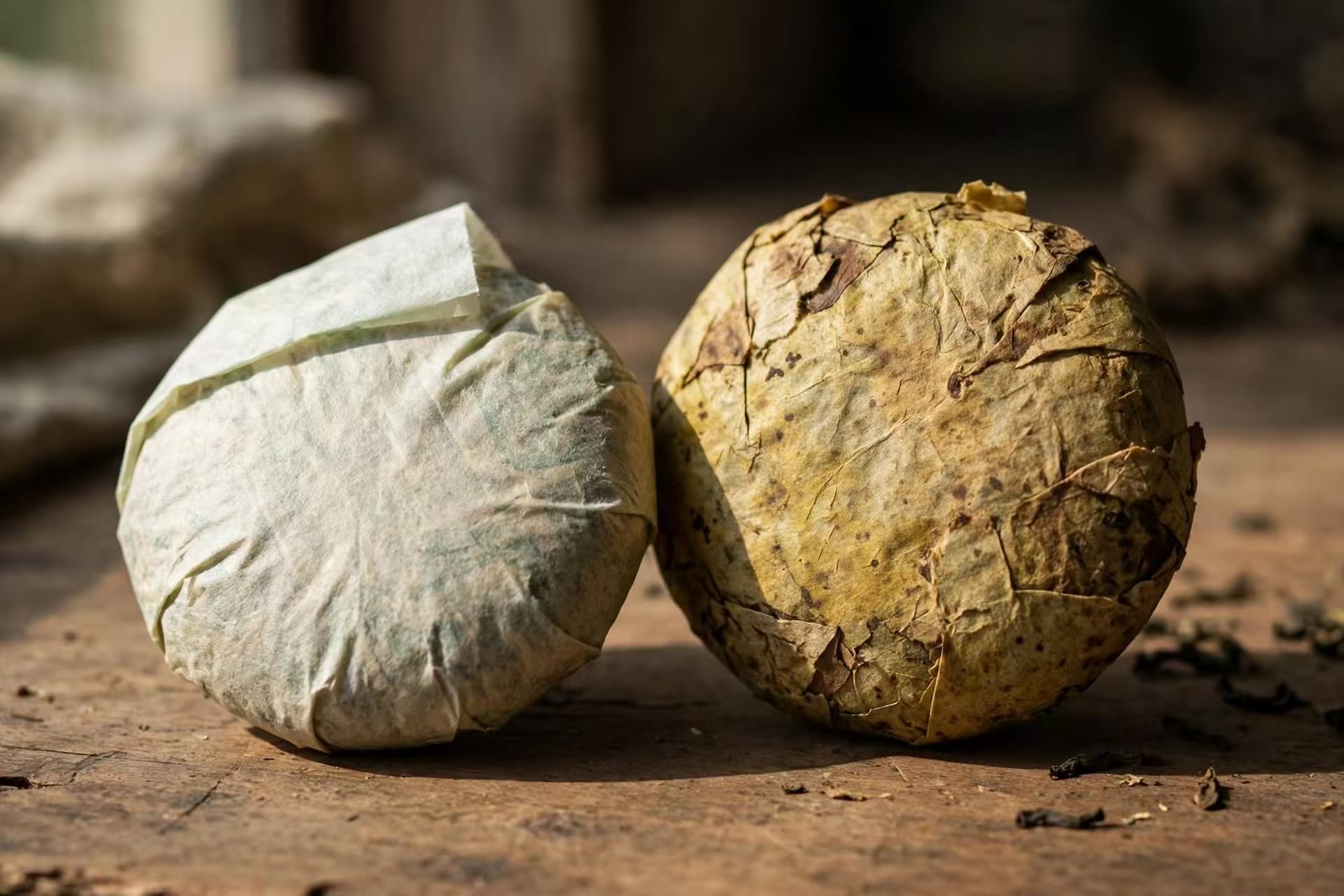
It is a comforting idea. You buy a cake of pu-erh, tuck it away, and assume that time will quietly tidy up any problem in the leaf. Years later, the tea is mellow, aromatic and — by this logic — cleaner. The claim is repeated often enough that it feels like common knowledge.
It is also not something you can rely on. There is no credible basis for saying that aging reliably removes pesticide residues to safe levels. Whether a residue changes over time depends on the specific substance, the conditions and the length of time involved, and there is no general guarantee that the result is safe. If you are buying or importing tea, that distinction matters a great deal.
Where the idea comes from
The myth has a plausible ring to it. Pu-erh is the tea that changes with age, and many biochemical processes continue slowly in a stored cake. It is reasonable to imagine that a residue present at harvest might fade as the years pass.
Two things get conflated here. The first is that a compound may change or break down over time under some conditions. The second is that the tea has become compliant and safe to sell. Those are not the same claim, and the second does not follow from the first.
A substance can degrade into other compounds, and "the original molecule is gone" does not automatically mean "the tea is now within the legal limit." It also does not tell you what the breakdown products are, whether they are within limits, or whether any of this happened in your particular cake. Without a test, you are guessing.
Degradation is substance-specific, time-specific and condition-specific
Here is the central point: there is no one rule that says "aging removes pesticides."
Different pesticides behave differently. Some are more persistent than others. Some break down mainly through exposure to light, others through moisture, heat or microbial action. Pu-erh storage is itself highly variable — a cake in a damp warehouse and a cake in a dry cupboard follow very different paths. So even if a particular residue declined under one set of conditions, that tells you almost nothing about a different cake in a different place.
Three variables dominate:
- The substance. Different active substances have different chemical behaviour. You cannot generalise from one to another.
- The conditions. Humidity, temperature, light, airflow and storage medium all shape what happens — and some of those same conditions can encourage mold, which brings its own contamination concerns.
- The time. "Aged" is not a standardised measurement. Two cakes sold as ten-year-old tea may have had very different histories.
Because the outcome depends on all three, there is no credible guarantee. The honest position is: we cannot assume aging makes a contaminated tea safe.
What the law says about processing a non-compliant product
There is also a legal reason to be cautious, and it is worth stating plainly.
Regulation (EC) No 396/2005 governs maximum residue levels of pesticides in food. Article 18(1) says products in Annex I must not contain residues above the applicable maximum residue levels — or, where no specific MRL is set, above the default of 0.01 mg/kg. Tea is listed as a commodity under Annex I, category 06, with code 0610000, and specific MRLs exist for many active substances on tea.
Crucially, Chapter III — Articles 18 and 19 — includes a prohibition on processing or diluting non-compliant products to bring them into compliance. That principle cuts directly against the "aging fixes it" story. If a product was above the limit, you cannot point to a process, a waiting period, or a blending step and call it compliant as a result. The rule is there precisely because "we did something to it" is not an acceptable route around a residue limit.
Aging is not a loophole. If anything, treating time as a substitute for compliance is the kind of thinking the rule is designed to prevent.
The 0.01 mg/kg default is not a target to age toward
A related misunderstanding is worth clearing up. People sometimes hear that the EU has a "zero residue" rule and assume anything below the default is automatically fine, or that a little time will push a residue under it.
The 0.01 mg/kg figure in Regulation 396/2005 is the default MRL — the legal limit that applies where no specific MRL is set for a product or where an active substance is not listed in Annex IV. It is a compliance limit at the level of quantification, not a safety threshold and not a blanket "zero residue" rule. It is a number for judging compliance, not a promise about a product's history.
If you want to know whether a tea meets a limit, you need a measured result from a laboratory and the correct applicable MRL for that substance on tea. The EU Pesticides Database is the official lookup tool for those values. Because it is a JavaScript application, exact per-substance values are not easily reproduced as plain text — which is exactly why you should check the current official database rather than trust a number copied into a sales listing.
Why sellers lean on the "aged is cleaner" line
This myth survives because it is convenient. A seller with an older cake and no test report can point to the age as if it were evidence. The story is hard to challenge in a conversation, because it sounds reasonable and is difficult to disprove without data.
That is the tell. When age is presented as proof of cleanliness, ask what is actually being claimed. If the answer is a process rather than a measurement, you have no compliance evidence.
A related phrase to treat carefully is "zero pesticide residue." It is a marketing phrase, not a regulatory category. A result of "not detected" means the residue was below the method's limit of detection — not that nothing was ever used, and not that the tea is free of every possible substance. What matters is what was tested, the method's limit of quantification, how the sample was taken, and when.
Commission Regulation (EC) No 333/2007 covers sampling and analysis methods for contaminants, and it illustrates a broader truth: a result is only as meaningful as the sampling behind it. Testing one bag does not certify a whole lot. So even a genuine test report needs to be read with its lot number, method and date attached.
What to do instead of trusting the aging story
If you buy or import pu-erh and residues are a concern, replace the assumption with a process.
- Ask for a COA that matches the lot. The report should identify the laboratory and its accreditation, the sample or lot, sampling and reporting dates, the analytes, the method, results with units, limit of quantification, and pass or fail against a stated limit.
- Match the lot to the cake. A report for a different batch is not evidence for the tea in your hand.
- Check what was tested. "Pesticide screen" is vague. Ask which active substances were included and what the limits of quantification were.
- Use an accredited laboratory. ISO/IEC 17025 is the international standard for the competence of testing and calibration laboratories.
- Store properly regardless. Aging under damp, dirty conditions can create mold risk, which is a separate compliance concern addressed by contaminant rules such as Regulation 1881/2006.
- Document your decisions. For a small importer, the file linking the goods to their report is what turns a claim into a defensible position.
Note that organic certification is a process standard, not a guarantee of zero residues; drift or contamination can still occur. Even with an organic cake, residue testing still matters. The same logic applies with force to an aged cake.
Bottom line
Aging does not reliably remove pesticide residues to safe levels, and there is no credible guarantee that it does. Breakdown depends on the substance, the conditions and the time, so a general promise is meaningless for a specific cake. Under Regulation (EC) No 396/2005, processing or diluting a non-compliant product to bring it into compliance is prohibited — time is not a legal workaround. The 0.01 mg/kg default is a compliance limit, not a target that aging helps you reach. Treat age as a flavour characteristic, not a safety credential, and insist on a lot-matched COA from a competent lab instead.
Sources & further reading
- Regulation (EC) No 396/2005 (pesticide MRLs) — https://eur-lex.europa.eu/eli/reg/2005/396/oj/eng
- EU Pesticides Database (MRLs) — https://ec.europa.eu/food/plant/pesticides/eu-pesticides-database/start/screen/mrls
- Commission Regulation (EC) No 333/2007 (sampling and analysis) — https://eur-lex.europa.eu/legal-content/EN/TXT/HTML/?uri=CELEX:02007R0333-20191214